
The Documents and Compliance Checklist for a Small Fragrance Order
A small fragrance order succeeds or fails on documents at least as often as on scent. The compliance pack - ingredient information, restriction reviews, safety and stability evidence, and any market notification - is what lets the product leave the factory, clear customs and sit legally on a shelf. Assemble the list before production, because every document the buyer requests late becomes a delay and a cost.
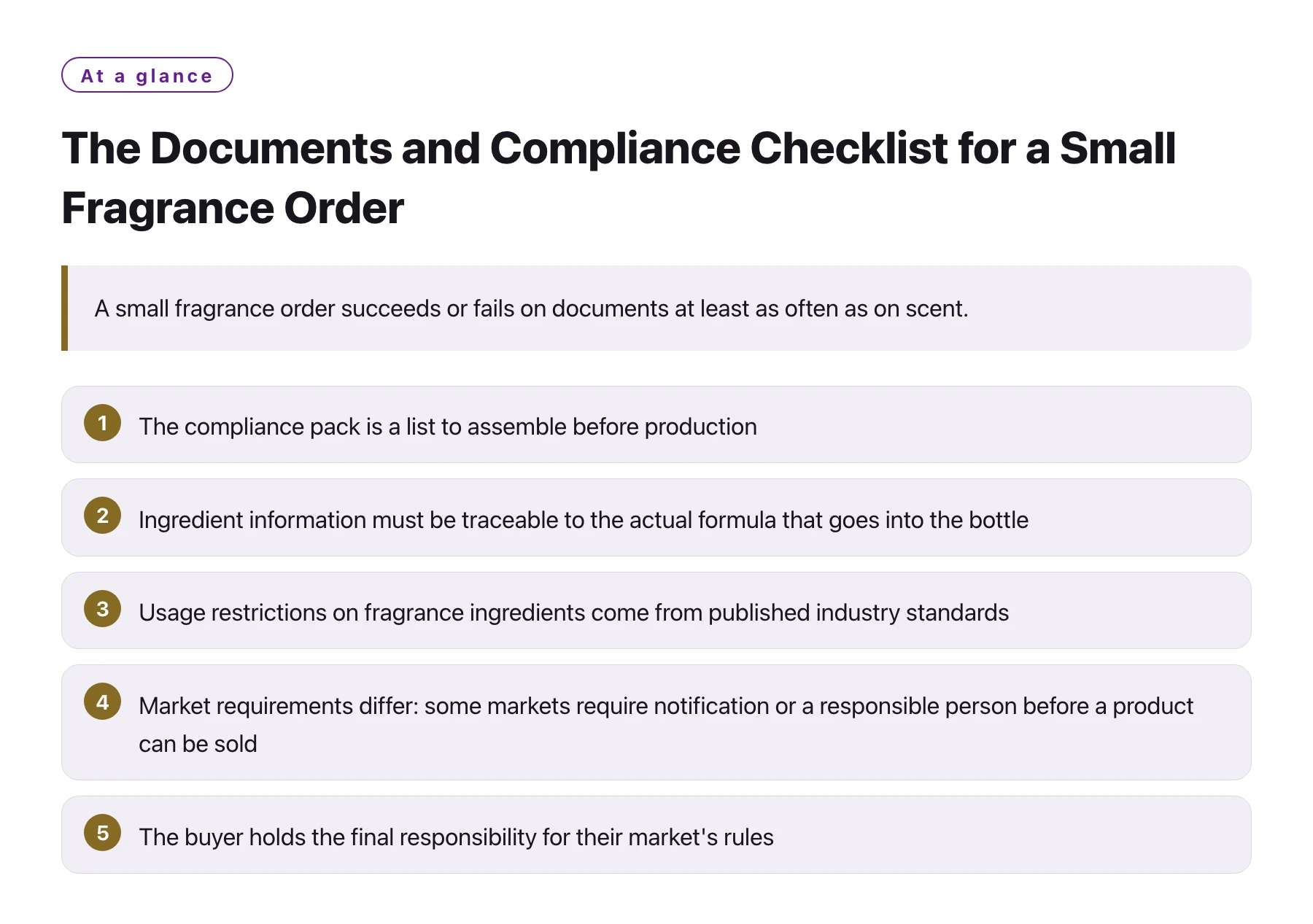
Key takeaways
- The compliance pack is a list to assemble before production, not after: ingredient documentation, restriction reviews, safety data and market notifications.
- Ingredient information must be traceable to the actual formula that goes into the bottle, so the pack has to be locked at formulation time.
- Usage restrictions on fragrance ingredients come from published industry standards, and the review should be checked against the current version.
- Market requirements differ: some markets require notification or a responsible person before a product can be sold, and the timing is part of the plan.
- The buyer holds the final responsibility for their market's rules; the manufacturer's pack is a strong starting point, never a substitute for market checks.
This checklist is written for a founder importing a first fragrance run, usually a few thousand units, who wants the product to reach the market without a compliance surprise. The principles are the same for larger volumes; the consequence of getting them wrong is simply easier to absorb at small scale.
The sections below cover the pack itself: what each document proves, where it comes from, and when in the timeline it has to exist. The table summarises the whole list, and the closing section explains who owns which part of the risk. A brand working with a manufacturer that documents its own scope openly, like Xuelei Fragrances, starts the compliance conversation with less guesswork, because the claims are already written down for the buyer to verify.
Start with the ingredient story
Everything else in the compliance pack hangs off the ingredient information. The formula's material list must be documented in a way that lets someone else check each ingredient against the rules that apply to cosmetics and fragrance products [1]. Fragrance materials are governed not only by general cosmetic ingredient rules but by the industry's usage restrictions, which are maintained through scientific assessment and published as a standards library [2].
The practical request to the manufacturer is simple: full ingredient documentation for the final formula, plus the restriction review that shows why the formula is compliant at its intended concentration. If those two documents cannot be produced, no amount of sales talk about the scent matters.
Why the ingredient story has to be locked early
The documents describe the actual formula that goes into the bottle. If the formula changes at the tweaking stage, the documents change with it, and every late change to the ingredient list means re-running the review. Locking the formula and the documents together at formulation time is the single cheapest way to keep the compliance pack honest.
The compliance pack, item by item
| Document | What it proves | When it must exist |
|---|---|---|
| Ingredient documentation | What is in the formula and at what level | At formulation time, before samples are approved |
| Restriction review | The formula is compliant with current usage limits | Before production, as part of the development handover |
| Safety assessment or data | The product is safe in its intended use | Before market launch, per destination market rules |
| Stability evidence | The product holds its quality for its shelf life | Before shelf-life claims are printed |
| Batch records | The actual run matches the approved formula | At production; kept per batch |
| Market notification or registration | The market has been told the product exists | Before first sale; timing varies by market |
Read the timeline column as the real schedule. A document needed at formulation time cannot be produced by a fast courier at customs; the buyer who sequences the pack into the project plan never learns this the expensive way.
Market rules: notification, responsible person and labelling
Different markets put different obligations on the person selling the product. In the European Union, cosmetics require a responsible person established in the EU and a product information file before the product is placed on the market, with the safety assessment as the core of that file [3]. Other jurisdictions operate notification systems or maintain restricted-ingredient lists that the seller must check before launch [4].
None of these obligations are solved by the factory automatically. A manufacturer that exports regularly will have a document structure that supports these requirements, but the legal responsibility for a specific market sits with the brand placing the product there. The buyer should treat the supplier's pack as the raw material of compliance, and the market-specific work as their own. When a manufacturer describes their OEM/ODM manufacturing services as covering documentation from the first enquiry, that wording should be checked against the quote, because the exact split of who prepares which document is a commercial term like any other.
Labelling as its own checklist
Labels carry their own compliance load: ingredient display, allergen listing where required, volume, and any claims about the product. The label is produced with the manufacturer's artwork process and must match the same ingredient documentation that drives the pack. Asking for a label proof against the ingredient list before printing is a cheap way to catch mismatches that would otherwise surface at retail inspection.
What the manufacturer should hand over
A serious export manufacturer treats the document pack as a deliverable with a defined structure. At the end of a first order, the buyer should hold: the ingredient documentation for the final formula, the restriction review reference, batch records for the run, certificates of analysis, and the export pack in the form the destination market expects. A manufacturer whose packs check out on a first small order has demonstrated the process the brand will rely on for every later order.
This is the point where the buyer's compliance planning and the supplier's service offer meet: working with a manufacturer that supports both development and production end to end simplifies who documents what, because the same counterpart that made the formula also holds its records. A perfume production partner in China with export experience usually has the pack structure ready to show, and its published service scope and certification list make the compliance conversation concrete from the first exchange. The practical test is simple: ask for the document structure before the deposit, and verify it against what the quote actually promises to deliver.
Keep one page in the project file called the compliance timeline: each document, the date it must exist, and the owner. Update it at every project meeting. The order that survives is not the one with the best scent; it is the one whose document dates never slipped.
Sources
- EU CosIng — Cosmetic Ingredient Database (European Commission) —— The European Commission's CosIng database of cosmetic ingredients, listing ingredient functions, restrictions and labelling requirements under EU cosmetics law.
- IFRA Standards Library (International Fragrance Association) —— The IFRA Standards Library lists the restrictions the fragrance industry applies to individual fragrance ingredients, based on safety assessments; it is the reference point for compliant fragrance formulation.
- European Commission: Cosmetics in the EU —— The European Commission's overview of EU cosmetics rules, including the responsible person, product information file and safety report requirements.
- Health Canada: Cosmetic Safety —— Health Canada's cosmetics pages, covering cosmetic notification, the ingredient hotlist and safety requirements for cosmetics sold in Canada.
Frequently asked questions
Which documents does a small fragrance import actually need?
Ingredient documentation, a restriction review, safety and stability evidence, batch records, and any market notification or registration, plus the label information. The exact list depends on the destination market, so build it from the market rules first.
Who is legally responsible for compliance in my market?
The brand placing the product in the market. A manufacturer's export pack is a strong starting point, but the market-specific obligations - notification, responsible person, labelling - sit with the seller.
When should I start assembling the compliance pack?
At formulation, not at shipping. Ingredient documentation and restriction reviews describe the actual formula, so the pack has to be locked with the formula. Late requests turn into delays and re-run costs.
Can the manufacturer produce the safety assessment for my market?
Manufacturers and their testing partners provide the data and often the assessment framework, but the qualified-safety-assessment step is normally tied to the responsible person in the destination market. Confirm the split before signing.
What happens if I skip the compliance pack on a first order?
The extra cost appears somewhere: customs holds, retailer rejections, relabelling, or a product that cannot legally be sold. For a small order the learning is cheaper, which is exactly why the first run is the right time to build the discipline.